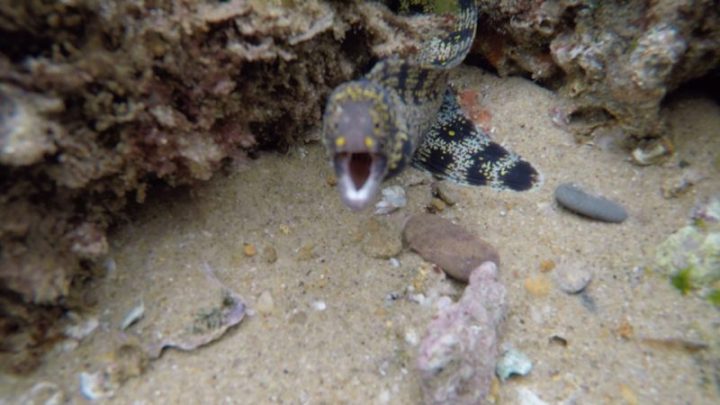
In this article I would like to tell you a little story about our favorite find from our last trip to Sodwana Bay January 2019. We are totally hooked on Snorkeling since we have discovered how fun snorkeling can be! Our most exotic find this time round was finding a very shy Marbled Electric Ray. Although what we have read up about them, they are extremely dangerous and give a whopper of a shock I don’t think they are very aggressive unless provoked. (Will research a little more about these animals later on in this article). So where did we find this shy creature? So we were swimming around in the shallow rock pools with a bunch of other people who were also snorkeling. We were mainly just chasing the normal common fish (will write about them in another article) when all of a sudden these two ladies called us over. At first we ignored them as we thought they were talking to each other, but when they called us the second time and gestured to us we went to investigated what they wanted to show us. When I saw the Sting ray it was swimming away to go hide in a nearby cave. So I called my fiancé over to dive deeper to try and catch this shy creature on our waterproof camera. He did! It was the coolest find we had made so far. Below is description of what it looks like and what exactly is a Marbled Electric Ray: ” What it looks like: The marbled electric ray (Torpedo marmorata) is a species of electric ray in the family Torpedinidae found in the coastal waters of the eastern Atlantic Ocean from the North Sea to South Africa. This benthic fish inhabits rocky reefs, seagrass beds, and sandy and muddy flats in shallow to moderately deep waters. It can survive in environments with very little dissolved oxygen, such as tidal pools. The marbled electric ray has a nearly circular pectoral fin disc and a muscular tail that bears two dorsal fins of nearly equal size and a large caudal fin. It can be identified by the long, finger-like projections on the rims of its spiracles, as well as by its dark brown mottled color pattern, though some individuals are plain-colored. Males and females typically reach 36–38 cm (14–15 in) and 55–61 cm (22–24 in) long respectively. Its Habitat: Widely distributed in the eastern Atlantic Ocean, the marbled electric ray is found from Scotland and the southern North Sea southward to the Cape of Good Hope, South Africa, including all around the Mediterranean Sea. It prefers temperatures cooler than 20 °C (68 °F). This species is typically found at depths of 10–30 m (33–98 ft) off Britain and Ireland, 20–100 m (66–328 ft) off Italy, and down to 200 m (660 ft) off Tunisia. It has been recorded from as deep as 370 m (1,210 ft). The marbled electric ray tends to be found deeper than the common torpedo (T. torpedo), which shares the southern portion of its range. Bottom-dwelling in nature, the marbled electric ray inhabits rocky reefs and seagrass beds, as well as nearby areas with sandy or muddy bottoms.[ During warm summer months, pregnant females are known to migrate into Arcachon Bay in northwestern France, where they are commonly found in very shallow, muddy pools near oyster beds.[ This species may conduct a northward migration in summer and autumn, into the waters of the British Isles.[ Its Food source: Small, benthic bony fishes constitute over 90% of the marbled electric ray’s diet by weight;[ these include gobies, hake, sea bass, mullets, jack mackerel, sea breams, goatfish, damselfish, wrasses, conger eels, and flatfish. Cephalopods such as European squid (Loligo vulgaris) and elegant cuttlefish (Sepia elegans) are a minor secondary food source. There is a single record of an individual that had swallowed a penaeid prawn, Penaeus kerathurus, and a study of captive rays found that they reject live Macropodiacrabs. Off southern France, by far the most important prey species is the leaping mullet (Liza saliens).[ Food items are swallowed whole; there is a record of a ray 41 cm (16 in) long that had consumed a three-bearded rockling (Gaidropsarus vulgaris) 34 cm (13 in) long. How does it defend it self? Because of its size and electrical defenses, the marbled electric ray does not often fall prey to other animals such as sharks. This species exhibits different defensive behaviors depending on whether a prospective predator grasps it by the disc or the tail. A ray touched on the disc will quickly turn toward the threat while producing electric shocks; this is followed by it fleeing in a straight line, after which it may re-bury itself. A ray touched on the tail will propel itself upward into a loop; if it has not escaped after the maneuver, the ray will curl into a ring with the belly facing outward, so as to present the area of its body with the highest electric field gradient (the underside of the electric organs) towards the threat; these behaviors are accompanied by short, strong electric shocks. The ray tends to produce more electric bursts when protecting its tail than when protecting its disc. Is it life threatening to humans? The shock delivered by the marbled electric ray can be painful but is seldom life-threatening, although there is a danger of a shocked diver becoming disoriented underwater. Its electrogenic properties have been known since classical antiquity, leading it and other electric fishes to be used in medicine. The ancient Greeks and Romans applied live rays to those afflicted with conditions such as chronic headaches and gout, and recommended that its meat be eaten by epileptics. That’s all for now guys be on the look out for our next article as we will be giving you more information about Sodwana Bay. Source: https://en.wikipedia.org/wiki/Marbled_electric_ray “