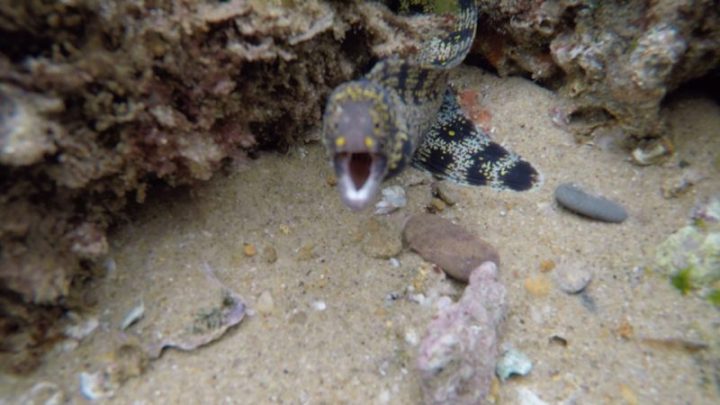
Snowflake Moray Eel @ Sodwana Bay

By Sodwana Bay

We enjoyed it so much finding new creatures in our adventures around the rock pools @ Sodwana Bay, especially on the days when the tides were really low! We were privileged enough to catch a couple of different eels in the rock pools. What was fun and also a challenge was trying to capture any eel we possibly could find on camera. Not an easy job for a bunch of amateurs to do. But we still managed to get a few on camera. Please bare in mind I took a few guesses from Internet photos to match up the type of eels that we took photos of, thus to say they might not all be the same type of eels and also their information could be inaccurate to the specific eel to. Below are some images of our own and Images from the Internet with various information about them: Little information is given about the creature its self except that people like to keep these eels as saltwater aquarium pets. But here is a little Info on what they are: The snowflake moray (Echidna nebulosa) also known as the clouded moray among many various vernacular names, is a species of marine fish of the family Muraenidae.[ It is widespread throughout the Indo-Pacific area from the eastern coast of Africa throughout Micronesia including the Red Sea and Hawaii.[ The species is also found in the eastern Central Pacific from southern Baja California, Mexico, and from Costa Rica to northern Colombia.[ This species reaches a length of 100 centimetres (39 in) but its common size is 50 centimetres (20 in). It lives at depths of between 2 and 30 metres (7 and 100 ft). Well that’s all for now guys. Stay tuned for our next article. Source Description: https://en.wikipedia.org/wiki/Snowflake_moray Source Photo: https://www.bluezooaquatics.com


Scuba Diving – Scuba Diving – Scuba Diving @ Sodwana Bay

By Sodwana Bay

Scuba diving blog, Scuba diving information, Scuba diving sites, Scuba dive, Scuba diving, Night diving, SCUBA diving equipment, PADI , EFR, Apeks, Aqualung, Suunto, Beauchat, Mares, Oceanic, ScubaPro, Northern Diver, Scuba Diving Courses, Dive Equipment, Dive Equipment Servicing, Dive Trips, PADI Courses, Scuba Diving, Rebreather, Technical Diving, Scuba Diver Training, Scuba Diving Equipment Servicing, PADI Courses, Scuba Diving Air Fills, Scuba Diving Gear, scuba diving, Open water scuba diving, Padi, Scuba, Diving, Durham City, Air, PADI Courses, PADI Open Water Diver, PADI Rescue Diver, Advanced Open Water, Learn to scuba dive, Scuba Diving, PADI Courses, Open Water, Deep Diving, Advanced Diving, scuba diving, padi, essex, dive gear, diving courses, padi scuba diving course, learn to scuba dive, scuba diving club, equipment servicing, air and nitrox compressed air fills, Scuba Diving Courses, Cardiff, Swansea, South Wales, PADI Diving Courses, Learn to Dive, Diving Equipment, scuba, diving, cornwall, falmouth, boat charter, Scuba diving courses, Commercial diving courses, Dive shop, Accommodation, Boating courses, scuba courses , scuba diving, Dive Centre, Open water, Discover Scuba, Dive School, Drysuit repairs, Scuba Diving equipment, Regulator servicing, Scuba Diving shop, Scuba courses lancashire, Durham, Padi, Scuba, Diving, Learn, padi scuba diving, learn to scuba dive in essex, padi open water diver, padi dive courses, scuba diving instructors in essex, scuba, diving, t shirts, clothing, jewellery, Scuba Diving, PADI, Dive Centre, Scuba Diving Equipment, Diving Equipment, Scuba Equipment, Dive Gear, Scuba Gear


Scuba Diving @ Sodwana Bay

By Sodwana Bay

Scuba Diving Terms and Phrases: A Advanced Open Water: Follow up certification after Open-Water Diver; allows for deeper Air: A gas mixture containing 21percent oxygen, 78 percent nitrogen, and 1 percent other gasses (mainly argon); compressed air is held in a tank for scuba diving. Apnea: Breath-holding; apnea diving is a type of freediving, but in scuba diving you should never hold your breath. Ascent: Rising to the surface when diving; typically at the end of a dive. Ascent Rate: How quickly a diver returns to the surface. You should never ascend faster than your bubbles as a safety precaution. Scuba Diving Terms and Phrases: B Backroll: Entering the water from the side of the boat, back first. BC/BCD: Buoyancy Compensator. This is the harness divers wear that hold the air tank and connects to the regulator. Bends/Bent: The pain a diver feels when suffering from Decompression Sickness (DCS). See DCS definition below. The bends often occur from ascending too quickly. Boat Dive: Scuba diving that requires a boat ride to the dive site. Bootie: Scuba gear divers wear with open-heel fins. Booties can range from thin (1 mm or less) to thick (7 mm) neoprene and protect your feet from the cold as well as sharp rocks and other hazardous things you could step on when shore diving. Bottom Time: The length of your dive. Buddy: The person you dive with; this is the person you discuss a dive plan with and you are both responsible for keeping each other safe. Buoyancy: (Positive, Negative, Neutral) Buoyancy refers to your position in the water. Things that sink are negatively buoyant; things that float are positively buoyant; scuba divers should be neutrally buoyant (floating in the middle). Scuba Diving Terms and Phrases: C C-Card: Proof of scuba certification that you receive after completing your training course. This is necessary to go diving without an instructor for open water divers and is proof of any secondary/specialty scuba training and certifications you have. Call: To “call a dive” means that you are choosing or being told to end the dive and return to the surface. Cave: A hollow place in the ground, typically of natural formation. Cave Diving: Entering a water-filled cave system either on scuba or freediving. Cave diving can extend thousands of feet into a cave system for people who are properly trained. Cavern: A semi-enclosed area (often a rock formation) where you can still see the entrance and Certified Diver: Someone who has completed scuba diving lessons through a training organization and is able to dive without an instructor. Certification Agency: An organization like PADI, NAUI or SSI that trains people to scuba dive. There are over 100 agencies that do this, but not all certifications are valid worldwide. Check-Out Dive: These are the dives completed outside of a pool (can be in a lake, ocean, spring, quarry, etc.) to prove that you’ve mastered a set of scuba skills and are necessary to complete scuba certification. Confined Water Dive: Dives conducted in a pool or other shallow, current-free underwater environment so that students can master training and skills in a safe, controlled environment before completing open-water check-out dives. Scuba Diving Terms and Phrases: D DAN: Divers Alert Network DCS/Decompression Sickness: When bubbles of gas (often nitrogen) get trapped inside of the body. There are varying levels of severity, and can be caused by swimming to the surface too quickly. Depth Gauge: A piece of scuba equipment that monitors how deep you are during your dive. Most dive computers serve as a replacement for depth gauges. Dedicated Dive Resort: Accommodations that focus on scuba diving experiences. They often have a dive shop onsite, and include diving in the booking fees. Dive Computer: A piece of scuba gear that monitors depth, bottom time and a ton of other information about each dive you complete. All dive computers are different, but they are an alternative to planning dives with dive tables. Dive Instructor: This person has gone through many trainings and certifications (open-water, advanced-open water, rescue diver, divemaster and more) so that they can teach others how to scuba dive. Dive Light: A flashlight designed for use underwater. Dive Operator: A store, boat or lcoation that will take you to go diving and often can certify you as well. Dive Table: Tool that helps determine how long you can safely stay underwater at different depths. Developed by the military to keep divers safe from decompression sickness Divemaster: A professional-level scuba diver who has logged at least 60 dives and who is trained to assist instructors on dive boats and during certification courses. DPV: Diver Propulsion Vehicle. A handheld and operated scooter or motor device that allows divers to move faster underwater. Drift Dive: Diving in a current, often from a boat. Once the dive is complete, the boat picks you up at the surface. Dry Bag: A bag to keep any items dry that aren’t waterproof. Drysuit: A type of exposure suit that keeps you dry while diving; used in cold-water dive conditions. Scuba Diving Terms and Phrases: E EAN: Enriched Air Nitrox. This is a form of mixed-gas scuba diving. Entry: Getting into the water either from shore, boat, etc. Equalize/Equalization: Putting air into an open area to compensate for the change in pressure. (Most commonly ear equalization for scuba divers.) Exposure Suit: A garment worn to keep divers warm and help protect them from cuts, scrapes and other elements. Scuba Diving Terms and Phrases: F Fins: The scuba gear that you wear on your feet to help you swim faster/with less effort. First Stage: Part of a scuba regulator; this attaches to the air tank. Freediving: Diving deep or staying underwater for extended periods of time without an air tank. Frog Kick: A technique for kicking your fins underwater. The bottoms of your feet move at each other like you’re sitting Indian style to propel you forward. This is a helpful technique to avoid kicking up sand. FSW: Feet of Sea Water Full-Foot Fin: A fin that covers your entire foot and most often doesn’t require you to wear a bootie. Scuba Diving Terms and Phrases: G, H, I, J, K, L Giant Stride: A method of getting in the water where you take a large step off…


Sodwana Bay Coasters – Colours and Shapes @ Sibaya – Sodwana Bay

By Sodwana Bay

So on this part of our coaster experimental project we decided to play around with Coaster colours and shapes: We have been having a lot of fun playing around with awesome new product. These coasters are all uniquely painted and none that look the same nor can be duplicated to look exactly a like. We even started cutting some of them to look like seahorses, although we haven’t gotten to lasering on the Coasters yet we have provided examples above with the laser image on plain white coasters. We are so excited to try these prints on true art pieces real soon! Stay tuned for the next step of this product! Please contact us @ 0813920467 or info@cheritree.co.za with any wood related projects which you might like us to build for you. Orders can be placed via email (with photos or examples please): info@cncit.co.za, or to check that theres a real person on the other side you can give us a call on: 081 392 0467;). All quotes will be given via Email only.


Sodwana Bay – Souveniers @ Sibaya – Sodwana Bay

By Sodwana Bay

Calling all Sodwana Bay lovers!!! Love Sodwana Bay? Wanna get a few souveniers without having to travel all the way to Sodwana Bay? Well we have some great news for you! CNC IT and Cheri Tree are both teaming up to bring those great Souveniers to you where ever you are in the country! The great thing about CNC IT and Cheri Tree teaming up is that you don’t need to stick to the normal things that you always see in Sodwana Bay, you can get your own great designs or ideas come to life. So get creative, send us your ideas and designs and see your dreams come to life! Here is an example of one of our great products in the making: Here we are making Sodwana Bay Coasters? Still playing around and figuring out what the best way will be to make them! NB! Shipping prices will be added to normal price of product. Please contact us @ 0813920467 or info@cheritree.co.za with any wood related projects which you might like us to build for you. Orders can be placed via email (with photos or examples please): info@flyingrocker.co.za, or to check that theres a real person on the other side you can give us a call on: 081 392 0467;). All quotes will be given via Email only. Please Note that CNC IT and Cheri Tree are both online shops only!


Strengthening environmental awareness @ Sibaya – Sodwana Bay

By Sodwana Bay

iSimangaliso: Strengthening environmental awareness and sustainable partnerships through sport The iSimangaliso Wetland Park Authority teamed up with local SMME and environmentalist Raymond Langa on 16 December for a community youth sports event at Khula Village, which borders the southern part of the World Heritage Site. The iSimangaliso and Dukuduku Sports Tournament event was hosted at the Nyamazaneni sports ground in Khula and was the finale in a round of games played in the month of November, organised by Raymond. He felt this would be an ideal vehicle to aid the message of conservation and environmental care which is so important to him. Raymond received training through one of iSimangaliso’s capacity building programmes and is an accredited Environmental Education facilitator working in the Park with dozens of school groups each year. According to Langa, “I am always frustrated by the environmental degradation activities taking place in areas of conservation significance. My area has many wetlands with an abundance of wildlife, seasonal birds and waterfowl. I have identified one area which is very significant to the entire village, but households living next to it dump all types of filthy items into it.” “To raise awareness, I approached the local school and conducted a workshop on the sustainable use of natural resources. Learners are studying Tourism in Grade 10, but they have little background of responsible tourism in their syllabus. I further invited locals to participate and promote environmental health to curb diseases as most of the litter is hazardous to both human beings and wildlife.” Following the clean-up activities, Langa was thrilled to notice that beautiful birds which had left the area started coming back to these rehabilitated wetlands. It was his drive and initiative that drove him to request a partnership with iSimangaliso in a sports event, and he opened the event with a talk on his environmental education activities, wetlands and the iSimangaliso Wetland Park. An introduction on iSimangaliso was also given by the Park’s Environmental Planner, Siboniso Mbense. He engaged with the youth by first asking questions to spectators for which he offered an iSimangaliso t-shirt or cap for the correct answer. These questions included identifying major problems faced by South African parks and the detrimental human impact on nature. iSimangaliso’s Slindile Msweli, Marketing Co-ordinator in charge of the logistics and a former bursary student supported by iSimangaliso, said that “the event gave iSimangaliso a platform to interact with the neighbouring communities, strengthen relationships and create awareness. The presentations were well received by the community present. You could see in other people’s faces the excitement of being part of this event; that made it special and it showed that even though thousands were not reached instantly an impact has been made on a few in one way or another, whether it’s a t-shirt they took away, bursary information or a few answered questions about the Park- that to me is an accomplishment.” Following the event it was gratifying to receive several letters of appreciation including from TM Mdletshe of Khula, who wrote to iSimangaliso to say: “We really appreciate what you did today at Nyamazaneni stadium. It’s given us the opportunity to learn and do something in life. I have gained more than I was expecting during today’s game. You taught me the importance of iSimangaliso and why we should protect our environment as youth.” Langa, on behalf of the Dukuduku communities and participants, said: “iSimangaliso showed a strong commitment to revive sustainable partnership with locals. Please pass my gratitude and best wishes to the entire staff, and management. From an environmental conservation perspective we need more similar gatherings, in order to achieve general support from the entire communities neighbouring the prestigious World Heritage Site.”