Marbled Electric Ray

By Sodwana Bay

Wow, what a find… and we didn’t have to go deep to find this beautiful Marbled Electric Ray. We were so excited to find this amazing creature especially in the rock pools. Usually all you see are the mundane fish, such as the sergeant major or the convict fish, than you get the occasional butterfly fish and the snowflake eels getting really upset that you found their awesome hiding spots. But this is a rare find for snorkelers, at the time of this find we were not certified scuba divers and were just playing in the kiddy pools (if you know what I mean)… I guess you can find more exciting things in the open waters but for the time being we stuck to the rock pools. Don’t get me wrong  the rock pools can be quite dangerous if you not careful…Take this electric Marbled ray for example – It can really pack a punch if it feels provoked or threatened.Sea urchins are also quite dangerous and if the tide is rough the rocks can hurt you as well. So I guess each sport has its own risks if you are willing to take it.Check out the video above and for more info on the Electric Marbled ray check out the link – An Exotic find- Marbled Electric Ray   

An Exotic find- Marbled Electric Ray @ Sodwana Bay

By Sodwana Bay

In this article I would like to tell you a little story about our favorite find from our last trip to Sodwana Bay January 2019. We are totally hooked on Snorkeling since we have discovered how fun snorkeling can be! Our most exotic find this time round was finding a very shy Marbled Electric Ray. Although what we have read up about them, they are extremely dangerous and give a whopper of a shock I don’t think they are very aggressive unless provoked. (Will research a little more about these animals later on in this article). So where did we find this shy creature? So we were swimming around in the shallow rock pools with a bunch of other people who were also snorkeling. We were mainly just chasing the normal common fish (will write about them in another article) when all of a sudden these two ladies called us over. At first we ignored them as we thought they were talking to each other, but when they called us the second time and gestured to us we went to investigated what they wanted to show us. When I saw the Sting ray it was swimming away to go hide in a nearby cave. So I called my fiancé over to dive deeper to try and catch this shy creature on our waterproof camera. He did! It was the coolest find we had made so far. Below is description of what it looks like and what exactly is a Marbled Electric Ray: ” What it looks like: The marbled electric ray (Torpedo marmorata) is a species of electric ray in the family Torpedinidae found in the coastal waters of the eastern Atlantic Ocean from the North Sea to South Africa. This benthic fish inhabits rocky reefs, seagrass beds, and sandy and muddy flats in shallow to moderately deep waters. It can survive in environments with very little dissolved oxygen, such as tidal pools. The marbled electric ray has a nearly circular pectoral fin disc and a muscular tail that bears two dorsal fins of nearly equal size and a large caudal fin. It can be identified by the long, finger-like projections on the rims of its spiracles, as well as by its dark brown mottled color pattern, though some individuals are plain-colored. Males and females typically reach 36–38 cm (14–15 in) and 55–61 cm (22–24 in) long respectively. Its Habitat: Widely distributed in the eastern Atlantic Ocean, the marbled electric ray is found from Scotland and the southern North Sea southward to the Cape of Good Hope, South Africa, including all around the Mediterranean Sea. It prefers temperatures cooler than 20 °C (68 °F). This species is typically found at depths of 10–30 m (33–98 ft) off Britain and Ireland, 20–100 m (66–328 ft) off Italy, and down to 200 m (660 ft) off Tunisia. It has been recorded from as deep as 370 m (1,210 ft). The marbled electric ray tends to be found deeper than the common torpedo (T. torpedo), which shares the southern portion of its range. Bottom-dwelling in nature, the marbled electric ray inhabits rocky reefs and seagrass beds, as well as nearby areas with sandy or muddy bottoms.[ During warm summer months, pregnant females are known to migrate into Arcachon Bay in northwestern France, where they are commonly found in very shallow, muddy pools near oyster beds.[ This species may conduct a northward migration in summer and autumn, into the waters of the British Isles.[ Its Food source: Small, benthic bony fishes constitute over 90% of the marbled electric ray’s diet by weight;[ these include gobies, hake, sea bass, mullets, jack mackerel, sea breams, goatfish, damselfish, wrasses, conger eels, and flatfish. Cephalopods such as European squid (Loligo vulgaris) and elegant cuttlefish (Sepia elegans) are a minor secondary food source. There is a single record of an individual that had swallowed a penaeid prawn, Penaeus kerathurus, and a study of captive rays found that they reject live Macropodiacrabs. Off southern France, by far the most important prey species is the leaping mullet (Liza saliens).[ Food items are swallowed whole; there is a record of a ray 41 cm (16 in) long that had consumed a three-bearded rockling (Gaidropsarus vulgaris) 34 cm (13 in) long. How does it defend it self? Because of its size and electrical defenses, the marbled electric ray does not often fall prey to other animals such as sharks. This species exhibits different defensive behaviors depending on whether a prospective predator grasps it by the disc or the tail. A ray touched on the disc will quickly turn toward the threat while producing electric shocks; this is followed by it fleeing in a straight line, after which it may re-bury itself. A ray touched on the tail will propel itself upward into a loop; if it has not escaped after the maneuver, the ray will curl into a ring with the belly facing outward, so as to present the area of its body with the highest electric field gradient (the underside of the electric organs) towards the threat; these behaviors are accompanied by short, strong electric shocks. The ray tends to produce more electric bursts when protecting its tail than when protecting its disc. Is it life threatening to humans? The shock delivered by the marbled electric ray can be painful but is seldom life-threatening, although there is a danger of a shocked diver becoming disoriented underwater. Its electrogenic properties have been known since classical antiquity, leading it and other electric fishes to be used in medicine. The ancient Greeks and Romans applied live rays to those afflicted with conditions such as chronic headaches and gout, and recommended that its meat be eaten by epileptics. That’s all for now guys be on the look out for our next article as we will be giving you more information about Sodwana Bay. Source: https://en.wikipedia.org/wiki/Marbled_electric_ray “


Snowflake Moray Eel @ Sodwana Bay

By Sodwana Bay

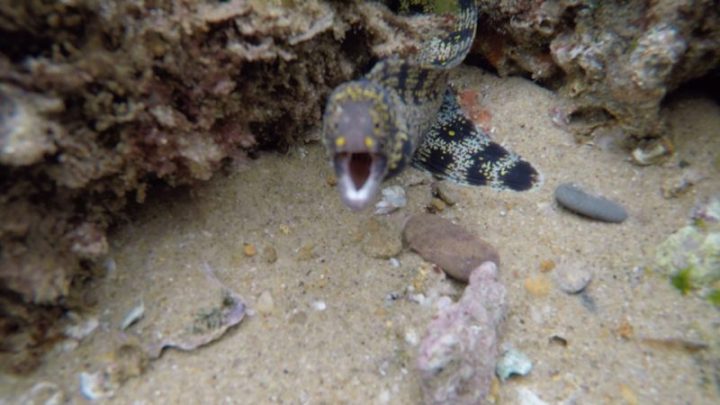
We enjoyed it so much finding new creatures in our adventures around the rock pools @ Sodwana Bay, especially on the days when the tides were really low! We were privileged enough to catch a couple of different eels in the rock pools. What was fun and also a challenge was trying to capture any eel we possibly could find on camera. Not an easy job for a bunch of amateurs to do. But we still managed to get a few on camera. Please bare in mind I took a few guesses from Internet photos to match up the type of eels that we took photos of, thus to say they might not all be the same type of eels and also their information could be inaccurate to the specific eel to. Below are some images of our own and Images from the Internet with various information about them: Little information is given about the creature its self except that people like to keep these eels as saltwater aquarium pets. But here is a little Info on what they are: The snowflake moray (Echidna nebulosa) also known as the clouded moray among many various vernacular names, is a species of marine fish of the family Muraenidae.[ It is widespread throughout the Indo-Pacific area from the eastern coast of Africa throughout Micronesia including the Red Sea and Hawaii.[ The species is also found in the eastern Central Pacific from southern Baja California, Mexico, and from Costa Rica to northern Colombia.[ This species reaches a length of 100 centimetres (39 in) but its common size is 50 centimetres (20 in). It lives at depths of between 2 and 30 metres (7 and 100 ft). Well that’s all for now guys. Stay tuned for our next article. Source Description: https://en.wikipedia.org/wiki/Snowflake_moray Source Photo: https://www.bluezooaquatics.com


Scuba Diving – Scuba Diving – Scuba Diving @ Sodwana Bay

By Sodwana Bay

Scuba diving blog, Scuba diving information, Scuba diving sites, Scuba dive, Scuba diving, Night diving, SCUBA diving equipment, PADI , EFR, Apeks, Aqualung, Suunto, Beauchat, Mares, Oceanic, ScubaPro, Northern Diver, Scuba Diving Courses, Dive Equipment, Dive Equipment Servicing, Dive Trips, PADI Courses, Scuba Diving, Rebreather, Technical Diving, Scuba Diver Training, Scuba Diving Equipment Servicing, PADI Courses, Scuba Diving Air Fills, Scuba Diving Gear, scuba diving, Open water scuba diving, Padi, Scuba, Diving, Durham City, Air, PADI Courses, PADI Open Water Diver, PADI Rescue Diver, Advanced Open Water, Learn to scuba dive, Scuba Diving, PADI Courses, Open Water, Deep Diving, Advanced Diving, scuba diving, padi, essex, dive gear, diving courses, padi scuba diving course, learn to scuba dive, scuba diving club, equipment servicing, air and nitrox compressed air fills, Scuba Diving Courses, Cardiff, Swansea, South Wales, PADI Diving Courses, Learn to Dive, Diving Equipment, scuba, diving, cornwall, falmouth, boat charter, Scuba diving courses, Commercial diving courses, Dive shop, Accommodation, Boating courses, scuba courses , scuba diving, Dive Centre, Open water, Discover Scuba, Dive School, Drysuit repairs, Scuba Diving equipment, Regulator servicing, Scuba Diving shop, Scuba courses lancashire, Durham, Padi, Scuba, Diving, Learn, padi scuba diving, learn to scuba dive in essex, padi open water diver, padi dive courses, scuba diving instructors in essex, scuba, diving, t shirts, clothing, jewellery, Scuba Diving, PADI, Dive Centre, Scuba Diving Equipment, Diving Equipment, Scuba Equipment, Dive Gear, Scuba Gear


Scuba Diving @ Sodwana Bay

By Sodwana Bay

Scuba Diving Terms and Phrases: A Advanced Open Water: Follow up certification after Open-Water Diver; allows for deeper Air: A gas mixture containing 21percent oxygen, 78 percent nitrogen, and 1 percent other gasses (mainly argon); compressed air is held in a tank for scuba diving. Apnea: Breath-holding; apnea diving is a type of freediving, but in scuba diving you should never hold your breath. Ascent: Rising to the surface when diving; typically at the end of a dive. Ascent Rate: How quickly a diver returns to the surface. You should never ascend faster than your bubbles as a safety precaution. Scuba Diving Terms and Phrases: B Backroll: Entering the water from the side of the boat, back first. BC/BCD: Buoyancy Compensator. This is the harness divers wear that hold the air tank and connects to the regulator. Bends/Bent: The pain a diver feels when suffering from Decompression Sickness (DCS). See DCS definition below. The bends often occur from ascending too quickly. Boat Dive: Scuba diving that requires a boat ride to the dive site. Bootie: Scuba gear divers wear with open-heel fins. Booties can range from thin (1 mm or less) to thick (7 mm) neoprene and protect your feet from the cold as well as sharp rocks and other hazardous things you could step on when shore diving. Bottom Time: The length of your dive. Buddy: The person you dive with; this is the person you discuss a dive plan with and you are both responsible for keeping each other safe. Buoyancy: (Positive, Negative, Neutral) Buoyancy refers to your position in the water. Things that sink are negatively buoyant; things that float are positively buoyant; scuba divers should be neutrally buoyant (floating in the middle). Scuba Diving Terms and Phrases: C C-Card: Proof of scuba certification that you receive after completing your training course. This is necessary to go diving without an instructor for open water divers and is proof of any secondary/specialty scuba training and certifications you have. Call: To “call a dive” means that you are choosing or being told to end the dive and return to the surface. Cave: A hollow place in the ground, typically of natural formation. Cave Diving: Entering a water-filled cave system either on scuba or freediving. Cave diving can extend thousands of feet into a cave system for people who are properly trained. Cavern: A semi-enclosed area (often a rock formation) where you can still see the entrance and Certified Diver: Someone who has completed scuba diving lessons through a training organization and is able to dive without an instructor. Certification Agency: An organization like PADI, NAUI or SSI that trains people to scuba dive. There are over 100 agencies that do this, but not all certifications are valid worldwide. Check-Out Dive: These are the dives completed outside of a pool (can be in a lake, ocean, spring, quarry, etc.) to prove that you’ve mastered a set of scuba skills and are necessary to complete scuba certification. Confined Water Dive: Dives conducted in a pool or other shallow, current-free underwater environment so that students can master training and skills in a safe, controlled environment before completing open-water check-out dives. Scuba Diving Terms and Phrases: D DAN: Divers Alert Network DCS/Decompression Sickness: When bubbles of gas (often nitrogen) get trapped inside of the body. There are varying levels of severity, and can be caused by swimming to the surface too quickly. Depth Gauge: A piece of scuba equipment that monitors how deep you are during your dive. Most dive computers serve as a replacement for depth gauges. Dedicated Dive Resort: Accommodations that focus on scuba diving experiences. They often have a dive shop onsite, and include diving in the booking fees. Dive Computer: A piece of scuba gear that monitors depth, bottom time and a ton of other information about each dive you complete. All dive computers are different, but they are an alternative to planning dives with dive tables. Dive Instructor: This person has gone through many trainings and certifications (open-water, advanced-open water, rescue diver, divemaster and more) so that they can teach others how to scuba dive. Dive Light: A flashlight designed for use underwater. Dive Operator: A store, boat or lcoation that will take you to go diving and often can certify you as well. Dive Table: Tool that helps determine how long you can safely stay underwater at different depths. Developed by the military to keep divers safe from decompression sickness Divemaster: A professional-level scuba diver who has logged at least 60 dives and who is trained to assist instructors on dive boats and during certification courses. DPV: Diver Propulsion Vehicle. A handheld and operated scooter or motor device that allows divers to move faster underwater. Drift Dive: Diving in a current, often from a boat. Once the dive is complete, the boat picks you up at the surface. Dry Bag: A bag to keep any items dry that aren’t waterproof. Drysuit: A type of exposure suit that keeps you dry while diving; used in cold-water dive conditions. Scuba Diving Terms and Phrases: E EAN: Enriched Air Nitrox. This is a form of mixed-gas scuba diving. Entry: Getting into the water either from shore, boat, etc. Equalize/Equalization: Putting air into an open area to compensate for the change in pressure. (Most commonly ear equalization for scuba divers.) Exposure Suit: A garment worn to keep divers warm and help protect them from cuts, scrapes and other elements. Scuba Diving Terms and Phrases: F Fins: The scuba gear that you wear on your feet to help you swim faster/with less effort. First Stage: Part of a scuba regulator; this attaches to the air tank. Freediving: Diving deep or staying underwater for extended periods of time without an air tank. Frog Kick: A technique for kicking your fins underwater. The bottoms of your feet move at each other like you’re sitting Indian style to propel you forward. This is a helpful technique to avoid kicking up sand. FSW: Feet of Sea Water Full-Foot Fin: A fin that covers your entire foot and most often doesn’t require you to wear a bootie. Scuba Diving Terms and Phrases: G, H, I, J, K, L Giant Stride: A method of getting in the water where you take a large step off…


Daily Devotional – The Refreshing Relief of Rejoicing

By Sodwana Bay

TODAY’S BIBLE VERSE Always be full of joy in the Lord. I say it again — rejoice! Philippians 4:4 During the six years I spent raising my son alone, both my parents died of cancer, my divorce became final, and my brother had a brain tumor removed. I prayed, worked, cared for my family, and went to church, all while trying to make my son’s world seem as normal as possible. Every morning the sun came up and I did what needed to be done. It seemed no one noticed the heavy burdens I carried. At times, the pressure built to where I thought the world was crushing me as it rested on my shoulders. Through those difficult years, I learned, like the Apostle Paul, to be content and face each day with renewed strength. I may fail from time to time, but I soon regroup and regain the victory through Jesus. Today, are you bearing life-altering burdens? Are you afraid one more struggle — one more small-hair of a problem — will break you? Do you feel buried beneath the load wondering if anyone cares or even notices? Take courage, Dear One, Jesus knows and Jesus cares. He holds the power to ease your burdens. He holds the key to your strength during difficult days. You can rely on Him when troubles come. Paul, writing to the church at Philippi, said he overcame the sufferings he experienced because of Christ’s strength fortifying his will to trust and endure. This strength and trust rose up in the heart of the Apostle and shouted, “I can do all things through Christ which strengtheneth me.” Philippians 4:13 (KJV) But how do we access Christ’s strength when we face hardships? The same way Paul did. We access Christ’s strength through rejoicing. Chained in a dark prison cell, Paul and Silas began to sing and thank God after being beaten and battered. As praise rose in their hearts and rejoicing flowed from their lips, Christ released His strength into their wills. God worked a miracle and many were saved because what went on in Paul and Silas’ hearts proved more powerful than their bonds. In the middle of our struggles, it is easy to forget our Christian experience has more to do with what is going on inside us than what is going on around us. Christ’s strength is released when we stop and rejoice in Him. As we rejoice, we are refreshed and relieved during times of hardships. Rejoicing refreshes us because it shifts our focus from our difficulties and places it on Jesus — the One who walks above the raging sea of life. Rejoicing relieves us because it substantiates our faith by shouting to our burdens, “I have faith in God, Who is good and Who is good to me, no matter what difficulties may come. I am and will be victorious through Him.” When we rejoice, we are showing those around us God is faithful, and we trust Him. Through rejoicing in Jesus, I stand victorious over those difficult years. Through rejoicing in Jesus, I greet the morning with a song of praise to my God. Through rejoicing, I face each day with renewed hope and trust in God’s promises. This same strength is available to you. What has God promised you? Has He promised you deliverance? Or victory? Has He promised you ministry? Or healing? Has He promised you forgiveness? Or security? God is willing and able to keep His word regardless of your circumstances. Continue to hold fast to His promise because what God has promised He will fulfill. In fact, “… all the promises of God in Him are Yes, and in Him Amen, …” 2 Corinthians 1:20(NKJV) And that, Dear One, is something to rejoice about. Through rejoicing, you can experience Christ’s strength and the refreshing relief of trusting Him Who is able to guide you safely through life’s gravest difficulties. “Rejoice in the Lord always: and again I say, Rejoice.” Philippians 4:4 (KJV) Copyright © January 2018. Used by permission.