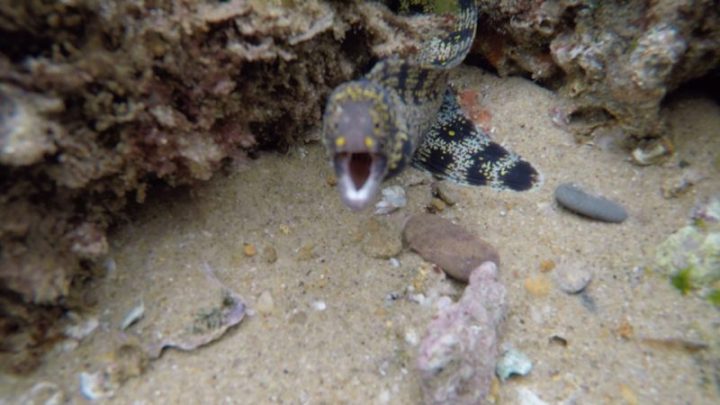
Snowflake Moray Eel @ Sodwana Bay

By Sodwana Bay

We enjoyed it so much finding new creatures in our adventures around the rock pools @ Sodwana Bay, especially on the days when the tides were really low! We were privileged enough to catch a couple of different eels in the rock pools. What was fun and also a challenge was trying to capture any eel we possibly could find on camera. Not an easy job for a bunch of amateurs to do. But we still managed to get a few on camera. Please bare in mind I took a few guesses from Internet photos to match up the type of eels that we took photos of, thus to say they might not all be the same type of eels and also their information could be inaccurate to the specific eel to. Below are some images of our own and Images from the Internet with various information about them: Little information is given about the creature its self except that people like to keep these eels as saltwater aquarium pets. But here is a little Info on what they are: The snowflake moray (Echidna nebulosa) also known as the clouded moray among many various vernacular names, is a species of marine fish of the family Muraenidae.[ It is widespread throughout the Indo-Pacific area from the eastern coast of Africa throughout Micronesia including the Red Sea and Hawaii.[ The species is also found in the eastern Central Pacific from southern Baja California, Mexico, and from Costa Rica to northern Colombia.[ This species reaches a length of 100 centimetres (39 in) but its common size is 50 centimetres (20 in). It lives at depths of between 2 and 30 metres (7 and 100 ft). Well that’s all for now guys. Stay tuned for our next article. Source Description: https://en.wikipedia.org/wiki/Snowflake_moray Source Photo: https://www.bluezooaquatics.com

Scuba Diving – Scuba Diving – Scuba Diving @ Sodwana Bay

By Sodwana Bay

Scuba diving blog, Scuba diving information, Scuba diving sites, Scuba dive, Scuba diving, Night diving, SCUBA diving equipment, PADI , EFR, Apeks, Aqualung, Suunto, Beauchat, Mares, Oceanic, ScubaPro, Northern Diver, Scuba Diving Courses, Dive Equipment, Dive Equipment Servicing, Dive Trips, PADI Courses, Scuba Diving, Rebreather, Technical Diving, Scuba Diver Training, Scuba Diving Equipment Servicing, PADI Courses, Scuba Diving Air Fills, Scuba Diving Gear, scuba diving, Open water scuba diving, Padi, Scuba, Diving, Durham City, Air, PADI Courses, PADI Open Water Diver, PADI Rescue Diver, Advanced Open Water, Learn to scuba dive, Scuba Diving, PADI Courses, Open Water, Deep Diving, Advanced Diving, scuba diving, padi, essex, dive gear, diving courses, padi scuba diving course, learn to scuba dive, scuba diving club, equipment servicing, air and nitrox compressed air fills, Scuba Diving Courses, Cardiff, Swansea, South Wales, PADI Diving Courses, Learn to Dive, Diving Equipment, scuba, diving, cornwall, falmouth, boat charter, Scuba diving courses, Commercial diving courses, Dive shop, Accommodation, Boating courses, scuba courses , scuba diving, Dive Centre, Open water, Discover Scuba, Dive School, Drysuit repairs, Scuba Diving equipment, Regulator servicing, Scuba Diving shop, Scuba courses lancashire, Durham, Padi, Scuba, Diving, Learn, padi scuba diving, learn to scuba dive in essex, padi open water diver, padi dive courses, scuba diving instructors in essex, scuba, diving, t shirts, clothing, jewellery, Scuba Diving, PADI, Dive Centre, Scuba Diving Equipment, Diving Equipment, Scuba Equipment, Dive Gear, Scuba Gear


Scuba Diving @ Sodwana Bay

By Sodwana Bay

Scuba Diving Terms and Phrases: A Advanced Open Water: Follow up certification after Open-Water Diver; allows for deeper Air: A gas mixture containing 21percent oxygen, 78 percent nitrogen, and 1 percent other gasses (mainly argon); compressed air is held in a tank for scuba diving. Apnea: Breath-holding; apnea diving is a type of freediving, but in scuba diving you should never hold your breath. Ascent: Rising to the surface when diving; typically at the end of a dive. Ascent Rate: How quickly a diver returns to the surface. You should never ascend faster than your bubbles as a safety precaution. Scuba Diving Terms and Phrases: B Backroll: Entering the water from the side of the boat, back first. BC/BCD: Buoyancy Compensator. This is the harness divers wear that hold the air tank and connects to the regulator. Bends/Bent: The pain a diver feels when suffering from Decompression Sickness (DCS). See DCS definition below. The bends often occur from ascending too quickly. Boat Dive: Scuba diving that requires a boat ride to the dive site. Bootie: Scuba gear divers wear with open-heel fins. Booties can range from thin (1 mm or less) to thick (7 mm) neoprene and protect your feet from the cold as well as sharp rocks and other hazardous things you could step on when shore diving. Bottom Time: The length of your dive. Buddy: The person you dive with; this is the person you discuss a dive plan with and you are both responsible for keeping each other safe. Buoyancy: (Positive, Negative, Neutral) Buoyancy refers to your position in the water. Things that sink are negatively buoyant; things that float are positively buoyant; scuba divers should be neutrally buoyant (floating in the middle). Scuba Diving Terms and Phrases: C C-Card: Proof of scuba certification that you receive after completing your training course. This is necessary to go diving without an instructor for open water divers and is proof of any secondary/specialty scuba training and certifications you have. Call: To “call a dive” means that you are choosing or being told to end the dive and return to the surface. Cave: A hollow place in the ground, typically of natural formation. Cave Diving: Entering a water-filled cave system either on scuba or freediving. Cave diving can extend thousands of feet into a cave system for people who are properly trained. Cavern: A semi-enclosed area (often a rock formation) where you can still see the entrance and Certified Diver: Someone who has completed scuba diving lessons through a training organization and is able to dive without an instructor. Certification Agency: An organization like PADI, NAUI or SSI that trains people to scuba dive. There are over 100 agencies that do this, but not all certifications are valid worldwide. Check-Out Dive: These are the dives completed outside of a pool (can be in a lake, ocean, spring, quarry, etc.) to prove that you’ve mastered a set of scuba skills and are necessary to complete scuba certification. Confined Water Dive: Dives conducted in a pool or other shallow, current-free underwater environment so that students can master training and skills in a safe, controlled environment before completing open-water check-out dives. Scuba Diving Terms and Phrases: D DAN: Divers Alert Network DCS/Decompression Sickness: When bubbles of gas (often nitrogen) get trapped inside of the body. There are varying levels of severity, and can be caused by swimming to the surface too quickly. Depth Gauge: A piece of scuba equipment that monitors how deep you are during your dive. Most dive computers serve as a replacement for depth gauges. Dedicated Dive Resort: Accommodations that focus on scuba diving experiences. They often have a dive shop onsite, and include diving in the booking fees. Dive Computer: A piece of scuba gear that monitors depth, bottom time and a ton of other information about each dive you complete. All dive computers are different, but they are an alternative to planning dives with dive tables. Dive Instructor: This person has gone through many trainings and certifications (open-water, advanced-open water, rescue diver, divemaster and more) so that they can teach others how to scuba dive. Dive Light: A flashlight designed for use underwater. Dive Operator: A store, boat or lcoation that will take you to go diving and often can certify you as well. Dive Table: Tool that helps determine how long you can safely stay underwater at different depths. Developed by the military to keep divers safe from decompression sickness Divemaster: A professional-level scuba diver who has logged at least 60 dives and who is trained to assist instructors on dive boats and during certification courses. DPV: Diver Propulsion Vehicle. A handheld and operated scooter or motor device that allows divers to move faster underwater. Drift Dive: Diving in a current, often from a boat. Once the dive is complete, the boat picks you up at the surface. Dry Bag: A bag to keep any items dry that aren’t waterproof. Drysuit: A type of exposure suit that keeps you dry while diving; used in cold-water dive conditions. Scuba Diving Terms and Phrases: E EAN: Enriched Air Nitrox. This is a form of mixed-gas scuba diving. Entry: Getting into the water either from shore, boat, etc. Equalize/Equalization: Putting air into an open area to compensate for the change in pressure. (Most commonly ear equalization for scuba divers.) Exposure Suit: A garment worn to keep divers warm and help protect them from cuts, scrapes and other elements. Scuba Diving Terms and Phrases: F Fins: The scuba gear that you wear on your feet to help you swim faster/with less effort. First Stage: Part of a scuba regulator; this attaches to the air tank. Freediving: Diving deep or staying underwater for extended periods of time without an air tank. Frog Kick: A technique for kicking your fins underwater. The bottoms of your feet move at each other like you’re sitting Indian style to propel you forward. This is a helpful technique to avoid kicking up sand. FSW: Feet of Sea Water Full-Foot Fin: A fin that covers your entire foot and most often doesn’t require you to wear a bootie. Scuba Diving Terms and Phrases: G, H, I, J, K, L Giant Stride: A method of getting in the water where you take a large step off…


Activities in Sodwana Bay – South Africa @ Sibaya – Sodwana Bay

By Sodwana Bay

We recently had the privilege of taking a trip down to Sodwana Bay (South Africa). Our journey started in Pretoria, and took us (roughly/about) 8 hours to reach our destination – Emoyeni Dive Lodge, although the trip was long and most of the way kinda boring we were still holding out with excitement to see the ocean once again and to have an exciting adventure in Sodwana Bay! Our first day, we settled in our “new Chalet” which we would be calling home for the next 10 days. Packed all our clothes away, got comfortable with our new layout of things and went for a quick drive down to the beach (+- 15 min from our location). It was really awesome to take in the ocean after such a long drive – worth every penny spent. Quick tip if you are planing on going to the beach in Sodwana Bay, get yourself a Rhino Card which will set you back R250 per person. Its a once a year subscription fee that gives you access to any of the iSimangaliso Wetland Park gates for a measly R5 p/p per day – Community fee. You will be paying a hell of a lot more per day without this card. Trust me we did that once! Heres the link to the website – sodwanabayinformation.co.za/rhino-card Sodwana Bay is a great place for snorkelling  in the rock pools, and Scuba diving on the many reefs in the protected marine area, some dive charters cater for those who cannot dive and offer offshore snorkelling expeditions as well. Although this time round we stuck to the rock pools we still had massive amounts of awesome fun. There is plenty more Activities  to do in Sodwana Bay but that is a topic for another time… We had an amazing experience with Snorkelling in the rock pools on the days that were not so windy and the seas were a bit calmer. We got amazing video footage of the mesmerizing underwater world, and even caught a small Manta Ray on video swimming around in the rock pools near the ”preek stoel”. Luckily we never stepped on it as we only noticed it on our video when we got back home. Here is another tip: Don’t be discouraged if you don’t see any fish on the surface above the water ‘cause most of the time they are keeping a safe distance from you, but are really close by, the moment you stick your head under the water you will get to realize how many fish truly are all around you. Also make sure to get yourself a pair of booties from your local dive shop. You will seriously need them walking in those rock pools. They are relentlessly sharp. Scuba diving is the most popular thing to do in Sodwana Bay. Although I do not have my Scuba Diving certificate yet, from what I have heard it is an amazing experience. Almost every Camp/Lodge I have heard of and seen all cater for scuba divers. Whilst we were in Sodwana Bay  we took a day trip out to Mkuze Game Reserve, which is also part of the iSimangaliso Wetland Park. (You can also use youre Rhino Card to gain access there). It is situated about 30 min drive from Sodwana Bay driving to Hluhluwe. Although we never saw the Big Five, we were able to see a few hippos in the hideout area and lots of bucks. We will at least try again next time we go. Remember there is picnic areas around the Pan, so take a “tjoppie” with to Braai. The park also caters for board and Lodge where you can stay over night in a Chalet or in a tent. There is a gift shop + take away area as well. So come join the Community of Sodwana Bay, Zulu land and experience all the great stuff this great land has to offer! A special Thanks to Emoyeni Dive Lodge for accommodating us during our amazing Holiday!